It's About Time

If you have ever spent more that 5 minutes with me, it is fairly obvious that I love fitness. I have learned so much (sometimes the hard way) in the 30 years that I have been teaching. What better way to share my passion than to start a blog and pass on the information that I share with clients on a day-to-day basis.

Wednesday, March 20, 2013

Physical Fitness and its Role in Fighting Cancer


I love to have other people post on my blog.  It is so refreshing to hear how exercise has impacted the lives of many out there.  Melanie Bowen has written the article below about how exercise can help prevent cancer.  Melanie Bowen joined the Mesothelioma Cancer Alliance in  2011 as an awareness advocate for natural health and cancer cure initiatives.  You will often find her highlighting the great benefits of alternative nutritional, emotional, and physical treatments on those diagnosed with cancer or other serious illnesses.  Melanie also assists in social media outreach in her efforts to spread awareness.  In her spare time, you can find Melanie trying new vegan recipes, on her yoga mat, or spending time with her family.  Please enjoy her article.
Physical Fitness and its Role in Fighting Cancer

By now, almost everyone knows how certain activities affect the risk of developing cancer. The link between lung cancer and smoking has been well established, and many people know that asbestos exposure causes mesothelioma. However, many people do not know that your fitness level affects your chances of developing cancer and your odds of fighting it successfully. Here are a few facts about how physical fitness and cancer interact.

Cancer Prevention?

It has long been known that obesity is linked to a number of cancers. In addition to reducing the risk of heart attacks and strokes, doctors are now also telling patients that reducing their obesity will lower their cancer risk. Physical fitness combined with proper diet is the key to defeating obesity, and those who begin exercising will be less likely to develop cancer in the future.

However, studies have also shown that physical fitness has additional preventative effects. When researchers control for weight levels, they still see a correlation between being in great shape and being at a lower risk of cancer.

Endure Treatments Better?

One of the most difficult aspects of cancer is the fact that treatment can be so grueling. Chemotherapy is notoriously difficult, and those who endure chemotherapy know how draining it can be. Physical fitness can help people prepare for chemotherapy, and those who enter treatment in great shape will be better able to endure its rigors.

High levels of physical fitness can also help patients maintain a positive attitude through treatment. Studies have shown a correlation between physical fitness and mental health, and those who can enter treatment with a positive attitude will likely see better outcomes.

Recover From Treatment

Recovering from chemotherapy and other cancer treatments will be challenging, but research has shown that exercise can help. While it will take some time to get back to your former physical fitness levels, starting to walk as soon as possible can help place you on the road to recovery.
 Additionally, modern research has shown that those who remain in good shape after treatment has ended are less likely to develop cancer in the future. Physical fitness should be viewed as a means of reducing your likelihood of having to fight cancer again in the future. While exercise cannot completely prevent your cancer from returning, the correlation has been shown to be strong.
Feel free to check out more information from Melanie  http://www.mesothelioma.com/blog/authors/melanie/


Sunday, March 17, 2013

Metabolic Workout

Just what exactly is that?  Metabolic Conditioning Workout (MetCon) is a hot term used in our industry right now.  It can be executed several different ways but should incorporate these components.

  • Multi-energy pathway utilization (See below for explanation)
  • Multi-joint or compound exercises
  • High intensity
  • Limited rest
Metabolic refers how the body processes food into fuel allowing the muscles to perform.  When engaging in metabolic conditioning, you improve the muscles ability to use energy stores by improving their efficiency through a variety of metabolic pathways.  First, the energy for all physical activity comes from the conversion of high energy phosphates (ATP) to lower energy phosphates.  Since our muscles don't store much ATP we must constantly resynthesize it. The production can be achieved by using a coordinated response  of all energy systems contributing at different degrees.  You utilize three different systems in your body.  See chart below to learn about each system.

Energy Systems-Lisa Mathews


Phosphagen SystemAn effective workout for this system is short, very fast sprints on the treadmill or bike lasting 5–15 seconds with 3–5 minutes of rest between each. The long rest periods allow for complete replenishment of creatine phosphate in the muscles so it can be reused for the next interval.·         2 sets of 8 x 5 seconds at close to top speed with 3:00 passive rest and 5:00 rest between sets
·         5 x 10 seconds at close to top speed with 3:00–4:00 passive rest
GlycolysisThis system can be trained using fast intervals lasting 30 seconds to 2 minutes with an active-recovery period twice as long as the work period (1:2 work-to-rest ratio).·         8–10 x 30 seconds fast with 1:00 active recovery
·         4 x 1:30 fast with 3:00 active recovery
Aerobic SystemWhile the phosphagen system and glycolysis are best trained with intervals, because those metabolic systems are emphasized only during high-intensity activities, the aerobic system can be trained with both continuous exercise and intervals.·         60 minutes at 70%–75% maximum heart rate
·         15- to 20-minute tempo workout at lactate threshold intensity (about 80%–85% maximum heart rate)
·         5 x 3:00 at 95%–100% maximum heart rate with 3:00 active recoveryInformation provided by Jason Karp PhD, Idea Author/Presenter

I want to give you an example of a metabolic workout.  You can perform all of these exercises for 30 seconds and repeat these exercises for 4-6 rounds.  You will be utilizing both cardiovascular and strength components.  Remember that these types of exercise routines are not to be performed every day.  Work hard during your workout but be smart too.  

Good luck with these exercises.
  • Plie' squat with Bicep curl 4X/ tuck in weights and jump up 4X (See Video Below)
  • Deep Lunge with 4 rows/Hold deep front lunge and pull in back leg 4X (See Video Below)
  • Burpee/Overhead press 2-4X (See Video Below)
  • Walking Push Ups (See Video Below
REPEAT 4-6 X.  Keep your rests short between rounds. Videos were filmed for Tabata intervals but can be also used for your metabolic burn.  Thanks to Nick Allen for his help.


If you have any questions, please email me LisaMathews@comcast.net.  


Wednesday, March 6, 2013

How to beat these winter blues?


I happen to know this model.  Success story-She exercises now and is much happier.  Giggles.

Does our run of cold weather just want to make you go crazy and pull your hair out?  I know that spring is right round the corner, daylight savings is telling me so but I still feel cold.  I need a change to improve my mood and my workouts until I can get out side or see the sun on a regular basis.  

"If you are debilitated in the winter months in a way that seriously impacts the quality of your life, you may suffer from seasonal affective disorder (SAD).  Winter depression, as it is also called, is biochemical in nature, brought on my the lack of sunshine."

Exercise is a proven way to improve your mood.  Try some of these ideas to help you fight the funk you are in. 

  • Embrace the Season-Try and do an activity like snow shoeing, cross country skiing, skating and so on.  I know the snow is melting but there are still plenty of places to play in it.  We still have kids sledding down the big hill by our house.  Running back up the hill is a great form of cardiovascular exercise.  Here in Utah if the air quality is good, then bundle up and get out and enjoy the fresh air, no matter what the weather.
  • Swim-The pool is “Heated.”  Enjoy the warmth and still get your exercise in.  You don’t have to be a swimmer to enjoy this exercise change.  I’m a sinker not a swimmer but I can still get a great workout in the water. 
  • Running club-Join a running group or class.  Yes, you may be indoors at first but there will come a time when you can be outside.  I have a new running group starting this week and a lot of the time will be spent learning how to be a more efficient runner and improving your running  know-how. Find a fun race  that you can do together and work towards that fun event.
  • Treat yourself-Set some goals for yourself.  Once you reach those goals reward yourself with a new outfit, massage, or facial.  You deserve and it and it will be the boost you need to keep going.
  • Join a gym or get a trainer-If you can’t motivate yourself to keep going or beat the poor workout mood, then let a new class or your trainer motivate you.  They are there to motivate you but also push you to reach your goals.
  • Birkram Yoga-If you have tried all of the above activities and still need  some cheering up, then jump into this hot yoga class.  You won't have any problem warming up and you will feel much better both physically and mentally when you're done.


Let’s beat these blues together.

Monday, February 25, 2013

How To Exercise to Boost Your Immune System


There are so many things that can affect how we feel. Everywhere we go, we are exposed to germs and some of those aren’t very nice.  Add busy schedules that don’t allow us to get proper rest, hectic routines that don’t allow us to eat properly and everyday stresses that can weaken our body’s efforts to stay healthy and we may just come down with something ugly.  Exercise has so many benefits and several studies show that moderate, consistent exercise can actually help your immune system. 

The intensity and duration of exercise needed for supporting the immune system is less than the required amount needed for the best cardiovascular training.  Regular exercise such as brisk or moderate walking for 20-40 minutes every day, 5 days a week will increase the body’s ability to deal with infections.  During moderate exercise, immune cells circulate through the body more quickly and are better able to kill bacteria and viruses.  Some studies have shown that a regular program of brisk walking can bolster the immune system including the antibody response and the natural killer (T cell) response. 

After exercise ends, the immune systems generally returns to normal within a few hours, but consistent, regular exercise seems to make these changes a bit more long lasting.  “When Moderate exercise is repeated on a near-daily basis, there is a cumulative effect that leads to a long-term immune response.” Dr. David Nieman.

We know that exercise also can boost our mental wellness as well. Psychological stress can also impair immunity and lead to an increase of cold and flu infections.   It is not always clear whether exercise alone boosts the immune system directly or if it works through a link with the brain and the nervous system. 

Too much exercise at high levels can affect your immune system in a negative way.  Exercising at a higher intensity or lasting for more than 90 minutes can actually temporarily suppress your immune system.  It can also make you susceptible to illness for up to 72 hours after the exercise session.  When the body is stressed from higher levels of intensity, the body will produce certain hormones that temporarily lower immunity.  Cortisol and adrenaline (stress hormones) have been linked to increases susceptibility to infection to extreme exercisers.  If you are training for a long distance event or an extreme exercise situation, allow your body and your immune system to recover properly.   If you are already ill, you should also be careful of working out too hard.  Your immune system is already taxed by fighting your infection and additional stress from a tough workout could prolong your recovery. 

In general, if you have mild cold symptoms and no fever, light or moderate exercise may help you feel a little better and actually boost your immune system.  Intense or long duration exercise will only make things worse and keep you down long.  

Friday, February 22, 2013

Timing Your Calories

Study: A Calorie is just a Calorie.


In life, they say, timing is everything. The same may be true for losing weight as well. New research suggests that, while calories are important, whenyou consume them may have a significant effect on how much weight you lose.
Most weight-loss plans center around a balance between caloric intake and energy expenditure. However, new research sheds light on a new factor that is necessary to shed pounds: timing. Researchers from Brigham and Women's Hospital (BWH), in collaboration with the University of Murcia and Tufts University, have found that it's not simply what you eat, but also when you eat, that may help with weight-loss regulation.
“This is the first large-scale prospective study to demonstrate that the timing of meals predicts weight-loss effectiveness,” says Frank Scheer, Ph.D., M.Sc., director of the Medical Chronobiology Program and associate neuroscientist at BWH, assistant professor of medicine at Harvard Medical School and senior author on this study. “Our results indicate that late-eaters displayed a slower weight-loss rate and lost significantly less weight than early-eaters, suggesting that the timing of large meals could be an important factor in a weight-loss program.”
To evaluate the role of food timing in weight-loss efforts, researchers recruited 420 overweight participants to follow a 20-week weight-loss treatment program in Spain. The participants were divided into two groups: early-eaters and late-eaters, according to the self-selected timing of the main meal, which in this Mediterranean population was lunch. During this meal, 40 percent of the total daily calories are consumed. Early-eaters ate lunch anytime before 3 p.m. and late-eaters, after 3 p.m. They found that late-eaters lost significantly less weight than early-eaters and displayed a much slower rate of weight-loss. Late-eaters also had a lower estimated insulin sensitivity, which is a risk factor for diabetes.
Researchers found that timing of the other (smaller) meals did not play a role in the success of weight loss. However, the late-eaters—who lost less weight—also consumed fewer calories during breakfast and were more likely to skip breakfast altogether.
In the study, which was published in the January 29, 2013, issue of International Journal of Obesity, researchers also examined other factors that often play a role in weight loss, such as total calorie intake and expenditure, levels of the appetite hormones leptin and ghrelin, and sleep duration. Among these factors, they found no differences between the late-eater and early-eater groups, suggesting that the timing of the meal was an important and independent factor in weight-loss success.
“This study emphasizes that the timing of food intake itself may play a significant role in weight regulation,” explains Marta Garaulet, Ph.D., professor of physiology at the University of Murcia Spain, and lead author of the study. She suggests that weight-loss efforts should focus on not only caloric intake, macronutrient distribution and exercise, but the timing of meals as well.
In other words, it appears the old adage to "breakfast like a king, lunch like a prince and supper like a pauper" may be good advice after all.
Garaulet, M. et al. (2013). Timing of food intake predicts weight loss effectiveness. International Journal of Obesity, DOI: 10.1038/ijo.2012.229.

Tuesday, February 5, 2013

Information About Back Pain


Degenerative Disk Disease (DDD) is the most common catch phrase for back pain.  It afflicts many people and can be very painful and frustrating.  It occurs naturally as we age but can be aggravated or induced by trauma, injury, heavy lifting, obesity and heredity.  Nearly everyone experiences some disc degeneration after the age of 40.  Some people may even have some degeneration but don't have any symptoms.  DDD is not actually a disease but a condition where there is a breakdown in the disks.

"Part of the confusion probably comes from the term "degenerative" which implies to most people that the symptoms will get worse with age.  The term applies to the disc degenerating, but does not apply to the symptoms.  While it is true that the disc degeneration is likely to progress over time, the low back pain from degenerative disc disease usually does not get worse and in fact usually gets better over time.  Another source of confusion is probably created by the term "disease", which is actually a misnomer.  Degenerative disc disease is not really a disease at all, but rather a degenerative condition that at times can produce pain from a damaged disc."
Exercise can help prevent, and relieve back pain.  Most people with low back pain reduce their activity to avoid the discomfort and that is very understandable.  Others want to stretch to help relieve the back which may help in some circumstances but  can further traumatize strained muscles.  My solution is to strengthen the muscles that support your spine.  Avoiding movement or holding the back in a fixed position for too long can have an adverse affect on your healing and even cause other compensation issues.  The remedy is to pick the right exercises and strengthen your core.  Exercise in a controlled and progressive environment can help heal the back by bring blood to the injured area.  

Here are some exercises that can help you strengthen your core.

Dead Bug Series-  Lay on floor with feet on the floor, compress abdominal wall then alternate picking up  feet.  Do not let your body shift or  allow your low back lift off the floor as leg lifts up.  Vary timing for more of a challenge

Dead Bug-Start with legs in the air, alternate slowly dropping one leg towards the floor.  Avoid quick movement.  As leg is dropping concentrate on pulling in abdominals to avoid back lifting off the floor. You can also length the leg as it drops down towards the floor for an added challenge.

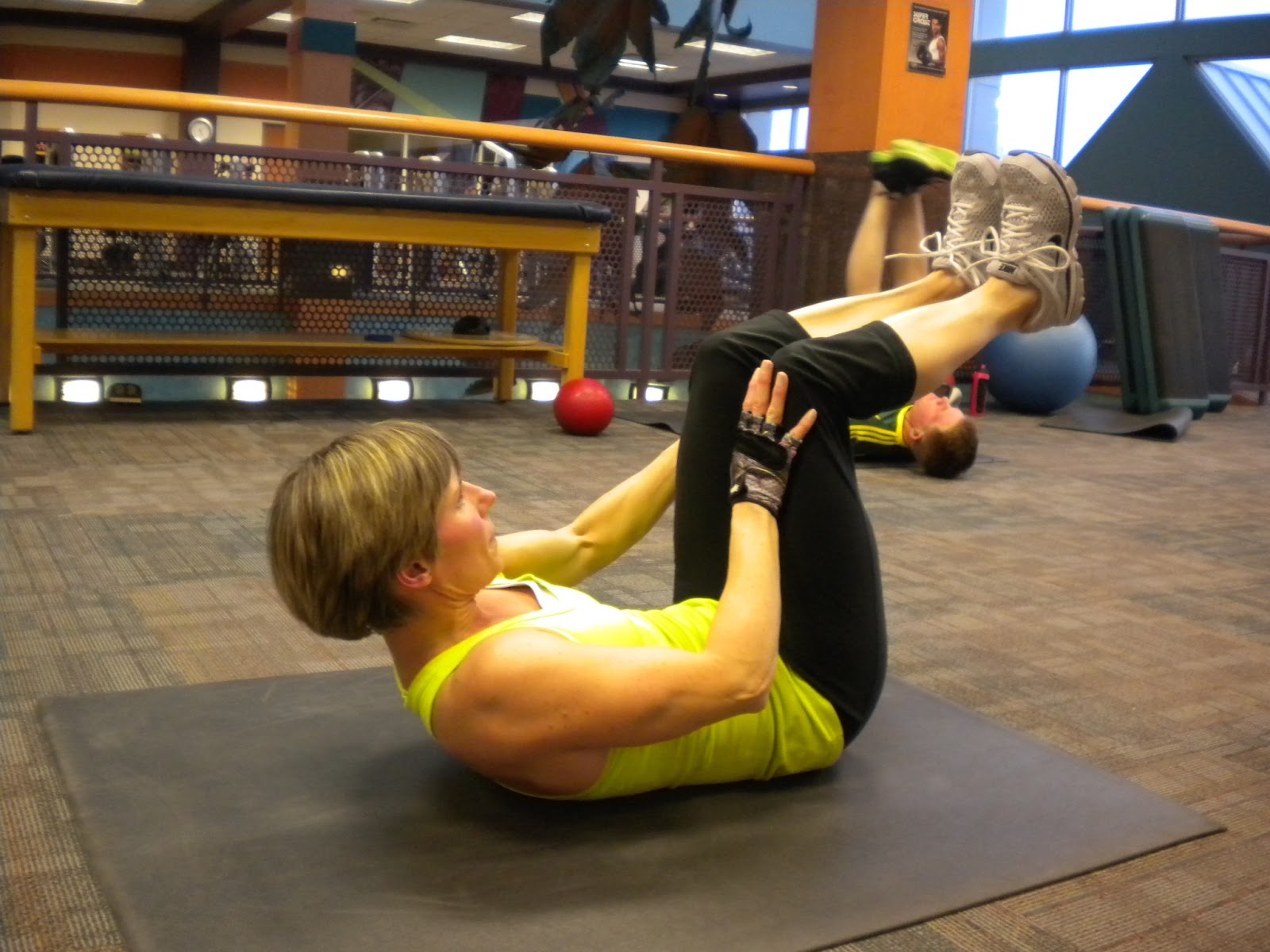
4-Part back stability series.  Lay on back,  Flex spine and curl up.  Press hands against  legs and  simultaneously pull knees into hands creating an isometric contraction.  Hollow and compress abdominals.  Hold for 15- 30 seconds depending on strength.  If you are straining at your neck, place a pillow under upper back for support.  

Part 2-Same starting position but arms are pulling and legs are pushing away to create the isometric contraction.  Hold  15-30 seconds
Part 3 and 4- Using opposing forces, push with one arm and pull with the other.  Keep shoulders square and  thighs parallel.  Hold on one side for 15-30 seconds and then repeat on other side for the same amount of time.   Thanks to my lovely model Theresa.  She is amazing.  Repeat this series 3 times.  
 

Monday, February 4, 2013

Don't Sweat It.. . . Not


This article was inspired by my workout today.  We did all lower body exercises with a 20 LB. weight vest on. Oh my.  It is a killer and every time I do it I sweat a ton.  As I removed my vest I noticed a distinct pattern on my top.  It was a heart.  I thought "How appropriate."  I love to sweat.  We all should "love" to sweat and there are many benefits to getting a little soggy when you train hard.
I asked my husband what shape he saw and he said "Mickey Mouse flexing."  For the sake of this article  look for the heart.
  • Sweat is like you body's air conditioning system.  It cools you down when you body gets overheated by exercise.
  • Sweating is very cleansing.  Because circulation is increased during exercise, many toxins and impurities may exit your body through your skin.
  • Sweating can help your skin.   When pores open up and it allows dirt and impurites to leave on the surface layers.
  • Effective exercising and sweat go hand in hand and those things can reduce stress.
  • Can also possibly help with your immune system.  As the body works hard it produces more white blood cells which in turn can help you keep from getting sick.
Don't worry about your hair or clothes.  Just get out there and sweat a little.